Speechify Releases Native Windows App That Runs Speech Models Locally
- Andrej Botka
- 1 апр.
- 2 мин. чтения

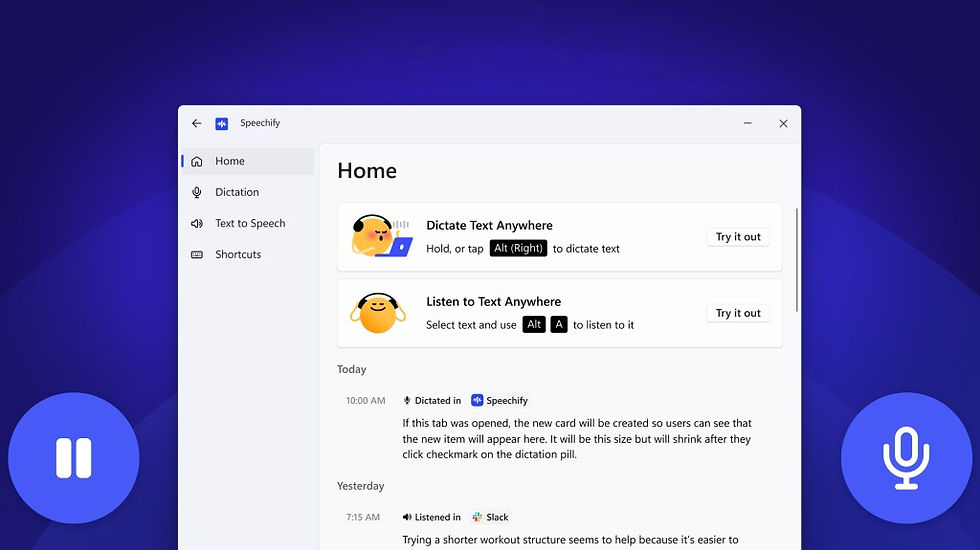
Speechify’s new Windows application lets users dictate into any program and have articles, PDFs or documents read aloud using on-device voice models, a move the company says enhances speed and privacy for both individual and business customers.
The app processes audio entirely on the computer for Copilot+ PCs equipped with dedicated neural processors from AMD, Intel or Qualcomm, and for other Windows 11 machines that rely on Intel or AMD graphics chips. That means speech recognition and synthesis can happen without sending audio to remote servers, though users can opt to route work through cloud services or swap models while the app is running.
On-device operation includes three separate machine-learning components: a speech synthesizer based on VITS, an instantaneous speech-segmentation module using Silero’s open-source detector, and a Whisper-derived transcriber for converting speech to text. The VITS component offers seven distinct playback tempos so listeners can choose how fast documents or web pages are narrated. Speechify also says it will let customers change between local and cloud models if they prefer different trade-offs between latency and accuracy.
“Windows runs on roughly one out of every one computer worldwide, so bringing a native client to PCs was a priority,” said Cliff Weitzman, the company’s founder and CEO, in an interview. “We want reading and writing to be accessible on whatever machine people use, and enterprise IT teams have been asking for a first-class desktop option.” He added that firms wary of sending internal audio off-site have shown particular interest.
The desktop release follows Speechify’s recent launch of meeting transcription features — until now limited to browser sessions. Industry observers expect the company to extend that capability so it can capture and summarize audio inside native applications as well as in web-based meetings. An independent analyst said local transcription can reduce delays and improve data control for corporate customers, while still allowing hybrid cloud workflows when organizations require it.
Speechify began as a tool primarily for converting text into spoken audio — reading news, emails and creating document-based podcasts. Over the past two years it has broadened its product set to include dictation, live meeting notes and a conversational voice helper, signaling a shift toward offering a full suite of voice tools for both consumers and workplaces. The company says its user base numbers in the tens of millions.
Комментарии